
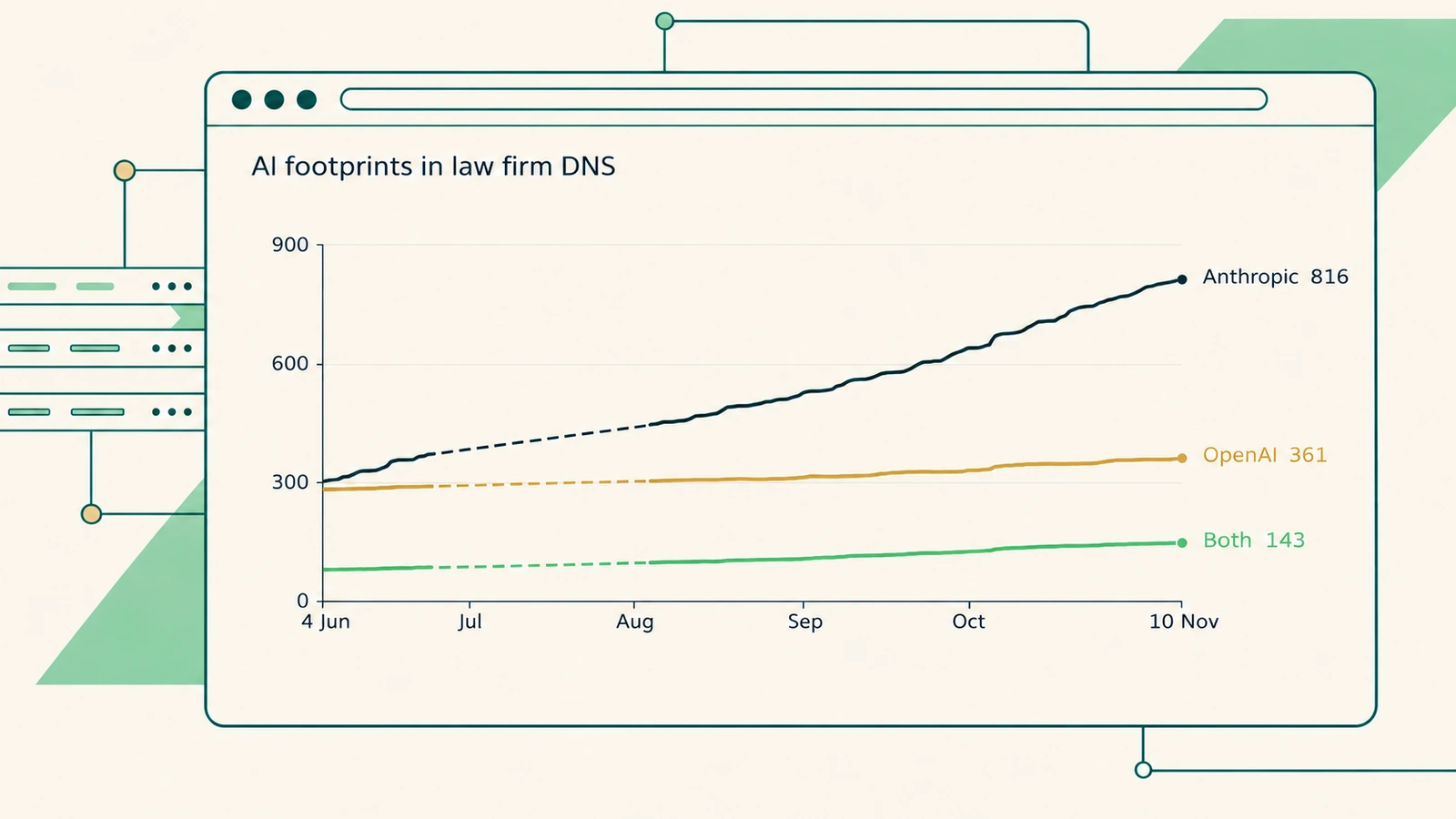
Anthropic is ahead in one visible part of the legal AI race: the domain-verification records published by law firms. In our 10 November snapshot, its footprint appears on 816 monitored firm records, compared with 361 for OpenAI. That is a 2.26-to-one lead.
These records are public clues to vendor-related domain setup. They let us measure a part of the market that firms rarely discuss in announcements. They also reveal a more interesting story than a simple winner-takes-all contest: 143 records carry both vendors, OpenAI continues to gain first appearances, and both companies are connecting their products to the systems lawyers already use.
OpenAI’s footprint is growing too
Our conservative addition analysis identifies 62 currently retained OpenAI first appearances after an earlier TXT observation, alongside 439 for Anthropic. In the latest 30 days to the snapshot, the corresponding counts are 14 OpenAI and 112 Anthropic. These exclude records already present at the first capture, replacement tokens and returning observations.
The chart follows when today’s verification footprints first appeared in our saved DNS observations. It starts on 4 June, after more than 99% of the current cohort had already received an initial capture. Anthropic’s cumulative observed count rises from 303 to 816; OpenAI’s from 282 to 361; and the count with both from 79 to 143. The stricter addition figures above apply further evidence checks, so they are a separate measure.
View the exact chart or download its daily DNS counts. Dashed segments connect missing observations. Both counts records where the two verification footprints were actually observed together and is included in each vendor total.
OpenAI had a head start. The legal-specific products are newer
The launch dates matter because ChatGPT, Claude, their business plans and their legal offerings arrived at different times. The current footprint cannot be explained simply by which company launched a chatbot first.
- 30 November 2022: OpenAI introduced ChatGPT as a public research preview.
- 2023: Anthropic introduced Claude on 14 March, followed by the Claude.ai public beta in the US and UK on 11 July. OpenAI launched ChatGPT Enterprise on 28 August.
- 2024: ChatGPT Team arrived on 10 January, later renamed Business. Claude Team followed on 1 May, with Claude Enterprise in September. OpenAI therefore had an earlier dedicated enterprise offering.
- 2025: Claude Code entered a research preview on 24 February. OpenAI introduced the Codex cloud agent on 16 May, with general availability on 6 October. These coding-agent milestones are distinct from the earlier chat products.
- 12 May 2026: Anthropic expanded Claude for Legal with more than 20 new connectors and 12 practice-area plugins, building on an earlier legal plugin.
- 17 September 2026: OpenAI introduced Astra for Law, initially for selected firms through Trusted Access in ChatGPT and Codex, with API access described as forthcoming at launch.
- October 2026: Anthropic added shareable legal artifacts on 28 October. Clio announced its Claude connector on 30 October, included with Clio Work.
That chronology puts the DNS findings in context. Anthropic’s lead appears alongside a substantial legal-workflow push, while OpenAI has both an established business product and a newer legal-specific offering. The announcements establish what became available; our observations show when a firm’s public configuration first became visible.
The race runs through legal platforms too
Direct access to Claude or ChatGPT is only one route into a law firm. Harvey announced Anthropic and Google models alongside OpenAI in May 2025. LexisNexis commercially launched Protégé General AI in October 2025 with choices from both Anthropic and OpenAI.
Anthropic gained another significant position when Thomson Reuters launched the next generation of CoCounsel Legal in the US on 20 August 2026, built on the Claude Agent SDK. OpenAI’s September legal announcement, meanwhile, named Harvey and Legora as platforms able to build on Astra for Law.
The competitive advantage is increasingly about reaching the lawyer inside a real workflow: the matter record, the contract, the research platform or the document repository. Our reading is that Anthropic’s public footprint is a sign of a strong position in that contest. A firm can still encounter either provider through a legal platform without publishing its own direct verification record.
Different measures can therefore tell different stories. The ABA’s survey conducted in late 2024 put ChatGPT first among tools respondents had adopted or were seriously considering. That earlier survey and our November 2026 DNS study measure different populations and behaviours. The lead reported here is specifically in public verification footprints.
Larger firms leave a much bigger AI footprint
Among records with a LinkedIn headcount of at least 1,000, 42.5% carry either vendor, compared with 2.0% below 50. Anthropic appears on 35.4% of the largest group and OpenAI on 18.4%. That concentration is consistent with larger organisations setting up managed access and domain verification more often.
The pattern also survives a freshness check: restricting the largest group to profiles refreshed within seven days produces a similar figure of 42.9%. Headcount is available for 21,191 records and measures people listing the organisation on LinkedIn.
Many firms are choosing both
| DNS footprint | Firm records | What is visible |
|---|---|---|
| Anthropic only | 673 | Anthropic verification |
| OpenAI only | 218 | OpenAI verification |
| Both | 143 | Both vendor verification records |
| Neither detected | 49,634 | Neither distinctive verification record |
Of the 361 records carrying OpenAI verification, 39.6% also carry Anthropic verification. In the other direction, 17.5% of Anthropic-footprint records carry OpenAI. There are 1,034 records with at least one of the two.
That overlap matters commercially. A second provider can enter an existing environment without displacing the first. For legal technology sellers, the better question is which workflow a new product can serve alongside what is already there.
The software around the AI layer
| Vendor or family | Firm records | Evidence |
|---|---|---|
| Docusign | 530 | Domain verification |
| Foxit | 161 | Domain verification |
| Clio | 41 | Domain verification |
| Nitro | 31 | Managed-identity verification |
| Adobe Acrobat Sign | 12 | Product-specific verification |
| DATEV | 267 | DATEVnet mail SPF reference |
| Zivver | 125 | Outbound-email SPF reference |
| Salesforce | 100 | Application-email SPF reference |
| Mailchimp | 535 | Sender-authorisation SPF reference |
Another 205 records carry Adobe enterprise-identity verification, which we keep separate from Acrobat Sign. Clio verification does not distinguish Manage from Grow. Among the 1,034 records with either AI footprint, 184 also carry Docusign verification; in the largest headcount group, the overlap is 65 of 90.
An added SPF provider does not replace the stack
One SPF record can authorise several email providers. Across the broader stored DNS inventory, 28.7% of SPF rows contain at least two distinct include targets. We compare the components so that adding Salesforce alongside an existing Microsoft reference counts as one added reference. Simply changing their order creates no new provider.
The conservative historical comparison found six monitored records adding Salesforce while retaining Microsoft, five adding Mailchimp alongside Microsoft, and three adding Zivver alongside Microsoft. SPF records authorise email senders, so these additions describe configured mail services.
What the DNS race tells us
Anthropic has the larger visible verification footprint, more retained first appearances in our stricter analysis, and a growing set of routes into legal work. OpenAI continues to add footprints and is expanding its own legal offering. The 143 records carrying both are a reminder that the next stage of the race can involve firms adding capabilities from several providers.
The opportunity for legal technology companies is to understand that environment. A public footprint gives the account researcher a concrete starting point: the vendors visible around the firm, the systems they may connect to, and the workflow the firm might improve next.
- Published 11 November 2026 using the 10 November DNS snapshot. The cohort contains 50,668 recently checked, identity-verified monitoring records. The unit is a firm record; one organisation can have several domains.
- The time graph follows cumulative first saved DNS observations among records carrying each footprint at the snapshot. Both requires a saved version containing both vendors. Dashed segments connect missing observations from 26 June to 4 August; the downloadable daily data leaves those dates empty.
- First appearances are observations, not purchase dates. The stricter addition count requires an earlier nonempty TXT observation, current retention and at least 24 hours of later persistence. Baselines, token changes and disappearance/reappearance artifacts do not count as new additions.
- Distinctive vendor verification and direct SPF references underpin the counts. OpenAI and Anthropic use verification across product and identity setups. These counts do not split Claude from Console, or ChatGPT from Codex, and do not measure active users or licences.